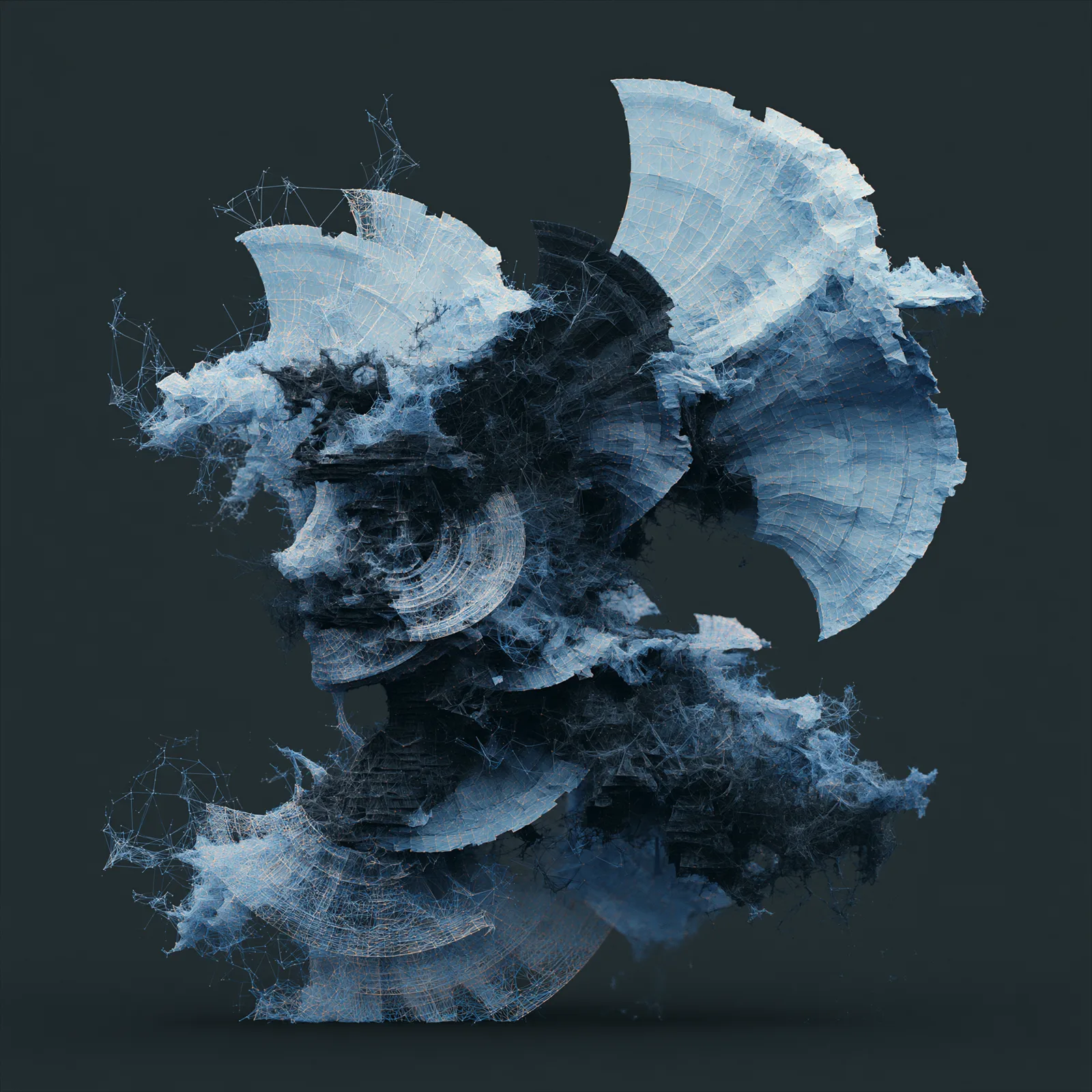
We take on the parts of a project that are easier to grow than to build by hand.
That can mean simulation, procedural geometry, volumetrics, or a system that needs to generate many controlled variations without rebuilding the same thing over and over.
SELECTED WORK / 02
Projects inside the field
Project facts paired with moving image and render material from the studio archive.01 / Houdini / atmospheric systems
Cloud Atlas
- PROBLEM
- Atmosphere had to be regenerated rather than repainted every time a shot changed.
- NOW
- A reusable Houdini core with phenomenon modules above it, clouds first, architected so further volumetric phenomena extend the core instead of forking it. In development.
- ROLE
- HDA architecture, procedural volume design and reusable production research.
- TOOLS
- Houdini / HDA00 / HDA01 / Volumes / VDB

02 / 3D / biological systems
CellLab
- PROBLEM
- Biological structure had to grow from a single cell into colony and tissue without losing the identity of what was already built.
- NOW
- A modular framework keeps simulation points, biological state and instanced geometry apart, so a change of form, behaviour or scale leaves dependent structures and their lineage intact.
- ROLE
- System architecture, procedural modelling and biological visual research.
- TOOLS
- Houdini / Procedural systems
FIELD NOTESRead the complete studio notes+
Our process usually starts with the phenomenon itself. We look at how it behaves, what drives its shape, what changes over time, and which controls actually matter to production. Then we build the Houdini setup around that logic.
The result can be a shot, an asset, an HDA, or a procedural system that stays useful when the brief changes.
LES Assets / Cloud Atlas grew out of this approach. It is being developed as an atmospheric generator with a reusable core, HDA00, and phenomenon-specific modules on top of it, starting with HDA01 for clouds. Inside it: procedural volumes and VDB, controlled density, formation logic, erosion and dissipation, detail and atmospheric variation. The structure is meant to keep growing into other volumetric phenomena without rebuilding the foundation every time.
CellLab is a modular procedural framework for biologically organised cells, tissue and behaviour. It builds outward from a cell prototype — membrane, cytoplasm, nucleus, nucleoli and organelles, chromatin, DNA and molecular systems — and then upward into cell behaviour, colony and tissue.
The architecture keeps three things apart: lightweight simulation points, persistent biological state, and instanced cell geometry. Modules carry input/output contracts, stable attributes, persistent IDs and lineage, deterministic generation, SDF-based constraints, validation, proxy and render modes, and safe recook. The problem being solved is continuity — a change in form, behaviour or scale should leave the dependent structures and their identity intact while one cell becomes a colony.
The working stack includes Houdini 22, SOP workflows, VEX, VOPs, HDA authoring, volumes and VDB, particles, dynamics, Karma and Mantra. When a shot needs it, the work continues into Nuke or After Effects.
Rendering, lighting and compositing are part of the same production experience. That changes how the Houdini work is built from the beginning: with the final image, revisions, hand-off and downstream work already in mind.
The background behind this comes from CG production since 2009 across animation, broadcast graphics, advertising, rendering, compositing, R&D and pipeline work, including Center-Nauch-Film-Animation, Parovoz and Cheil/Samsung, followed by independent technical and procedural work.
We can take on a Houdini stage, build an effect, develop a procedural asset or HDA, or join a team for a sequence that needs extra Houdini capacity.
YOU BRING
Tasks people arrive with
Real briefs from the work below — the shape of a first message, not a form.
- 01
Atmosphere had to be regenerated rather than repainted every time a shot changed.
- 02
Biological structure had to grow from a single cell into colony and tissue without losing the identity of what was already built.
FIRST STEP
Start with what you know.
Four questions, and what comes back: what we would take, and which part we would start with.- 01What are we making?
- 02What should it do or change?
- 03What already exists?
- 04Timing, format or constraints?
ANSWER THE FOUR PROMPTSOpens a short email brief+
PROJECT CHANNEL / 06
Start a conversation
Tell us what you are making, what the work needs to do, and where it needs to go.
Bird@InTheLES.studio↗