LES.GAMES explores interactive worlds, playable systems and experiences that respond to the participant.
The interest is in how characters, environments, mechanics, sound and visual language create a sense of presence and discovery — and in what has to be built underneath for that presence to hold.
SELECTED WORK / 04
Projects inside the field
Project facts paired with moving image and render material from the studio archive.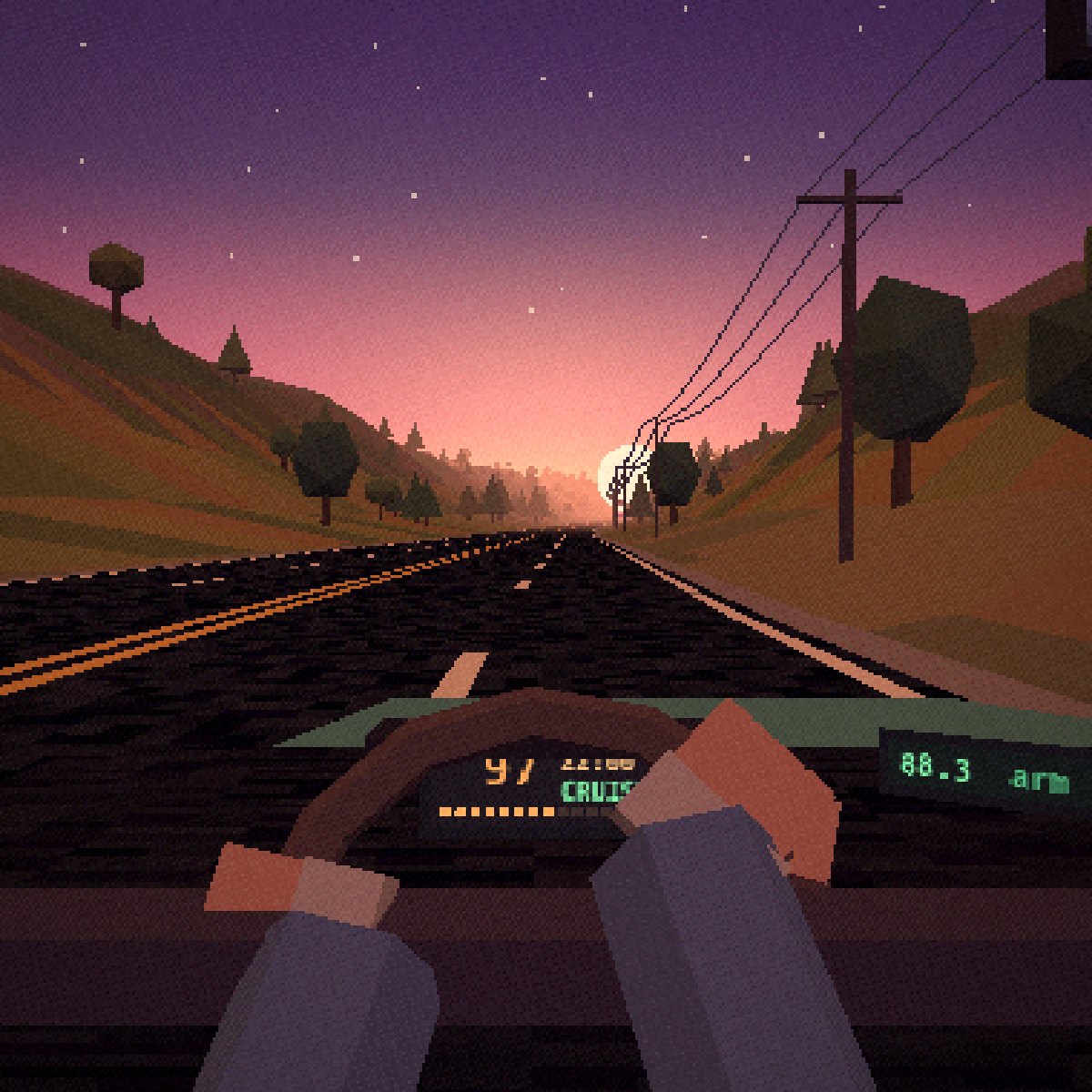
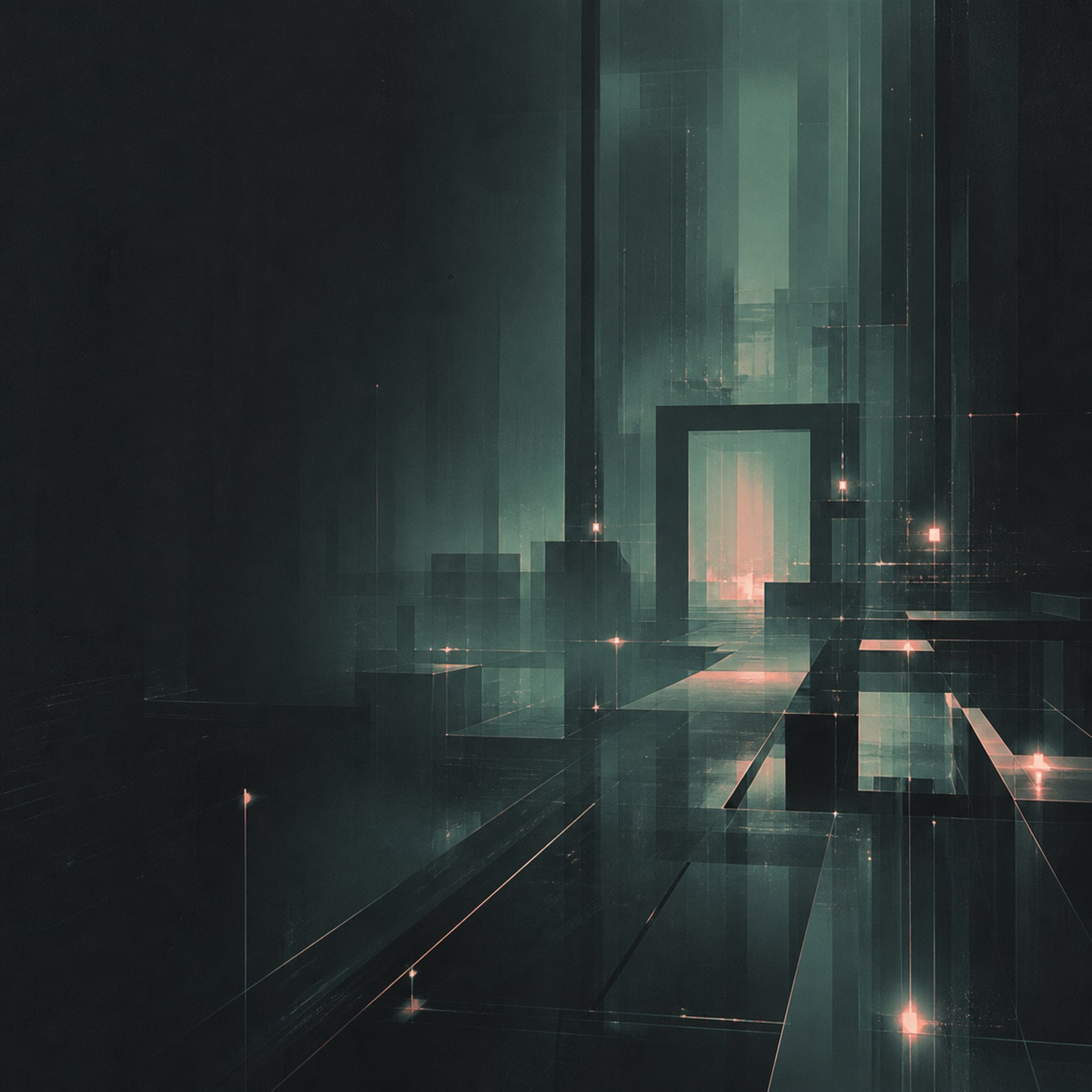
01 / Game / browser
HIGHWAY 22:00
- PROBLEM
- The studio had no game of its own that anyone could open and play in a browser, without installing anything.
- NOW
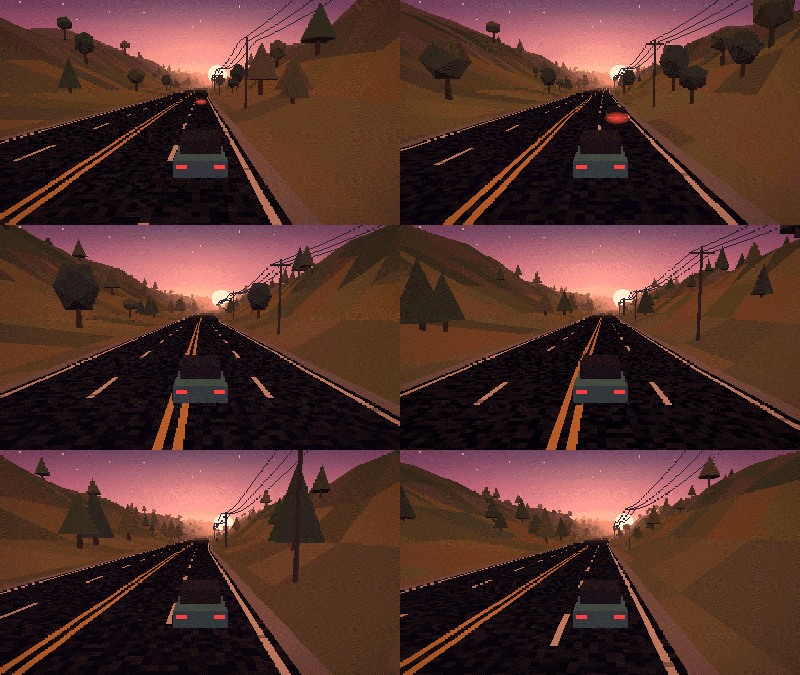
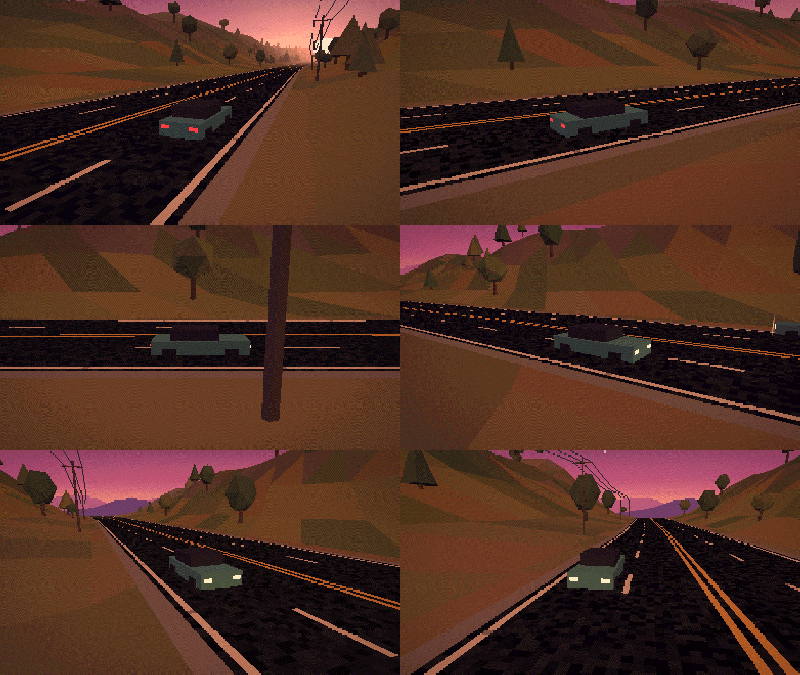
- An endless highway across the Middle Urals, always at 22:00 local time, with the sky set by today's date: sunset in late June, twilight in August, a moonlit night from September to April. Spruce taiga, birches that turn gold in autumn, snow from November, fog in the hollows, and elk, roe deer, foxes and hares stepping onto the road. A low-poly car with hands on the wheel, lo-fi textures, classic controls and a radio playing lo-fi rock and hip-hop that is generated live in the browser.
- ROLE
- Game design, real-time 3D, low-poly modelling and procedural music.
- TOOLS
- three.js / WebGL / Web Audio
02 / Real-time / WebXR
Particle Visualizer
- PROBLEM
- Interactive work needed half a million particles to stay alive on a screen and inside a headset — and to keep running when the device drops.
- NOW
- A WebGPU and WebXR engine of its own: GPU-resident particles, controller input, audio and MIDI reactivity, presets, recording, spatial audio and device-loss fallback. Currently 0.3.0-alpha.4.
- ROLE
- Systems engineering, interaction, audio and MIDI reactivity, spatial audio and recording.
- TOOLS
- WebGPU / WebXR / GPU compute / HRTF audio
03 / Game production / cutscenes
MORIII / Pathologic 3
- PROBLEM
- Physically plausible character animation still needed to arrive intact in scene assembly and camera work.
- NOW
- The hand-off between Cascadeur and Blender became a dependable production chain rather than a one-off workaround.
- ROLE
- Animation workflow, cross-application hand-off, scene assembly and cameras.
- TOOLS
- Cascadeur / Blender
04 / 3D / procedural environments
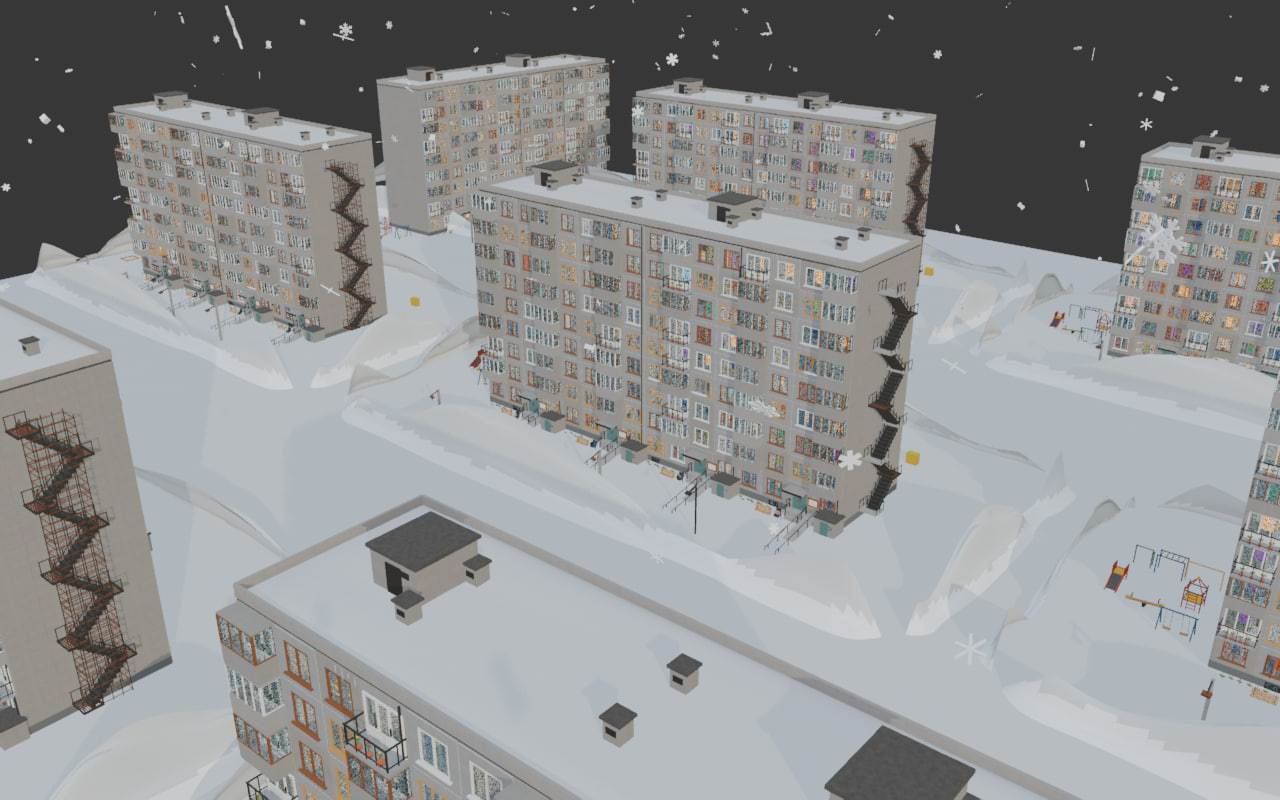
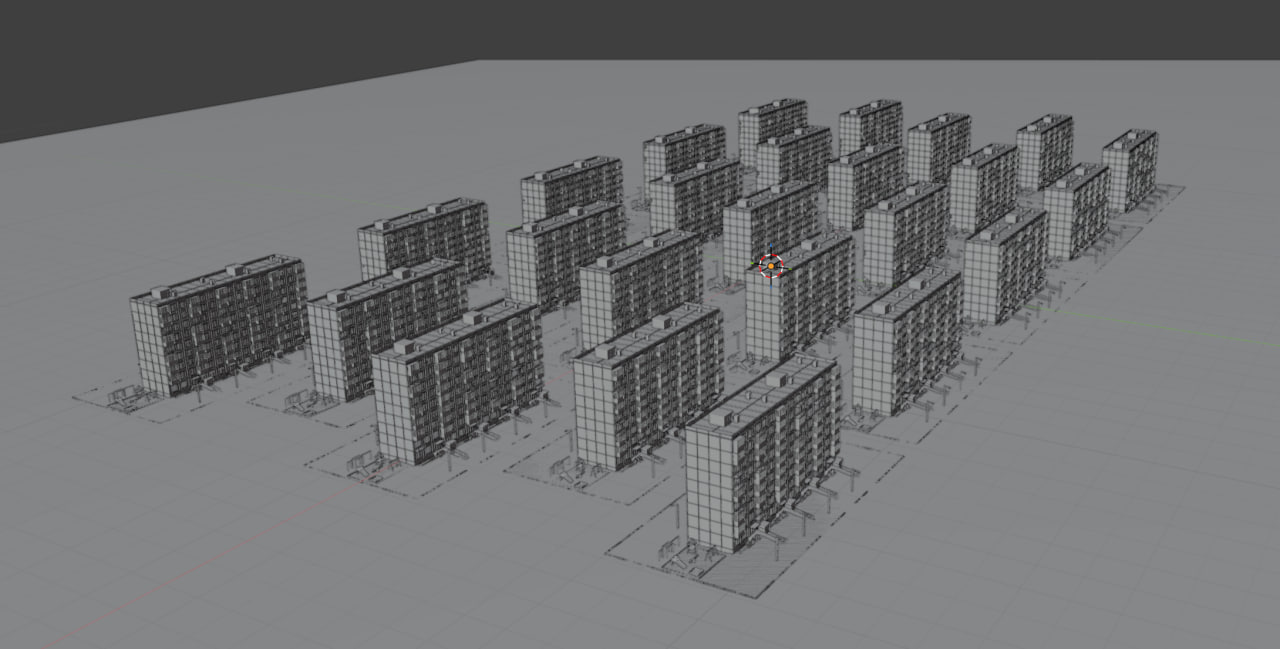
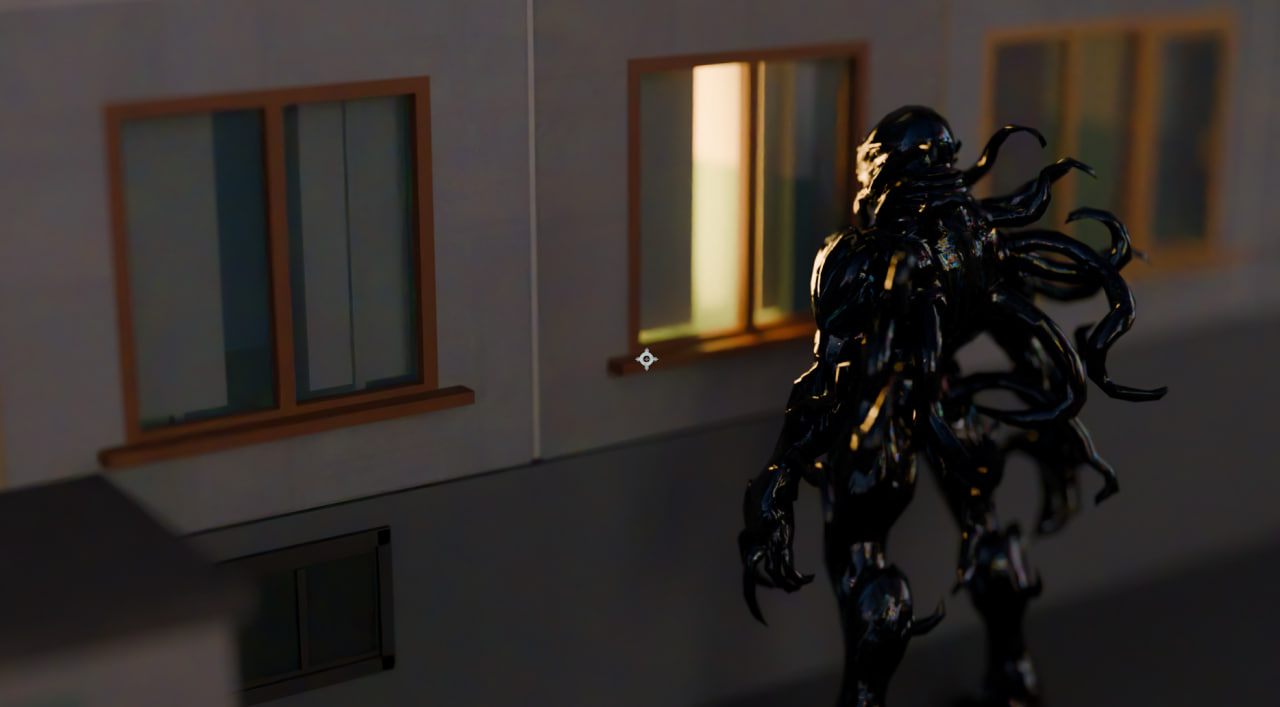
LUCID Panelka Generator
- PROBLEM
- A district could not be rebuilt by hand for every shot, note or late change. The environment had to stay controllable at the scale of a film.
- NOW
- A reproducible system generates buildings, courtyards and city-scale variation from parameters, while keeping the world editable and art-directable.
- ROLE
- Procedural world-building, production tooling, environment states and art-directable variation.
- TOOLS
- Blender / Python / Geometry Nodes
FIELD NOTESRead the complete studio notes+
HIGHWAY 22:00 is the studio’s first game, and it opens straight in the browser. An endless highway across the Middle Urals at 22:00, with the sky, snow and leaves set by today's date, fog in the hollows and elk, roe deer and foxes stepping onto the road: a low-poly car, hands on the wheel, lo-fi textures, classic controls and a radio playing lo-fi rock and hip-hop that is generated live rather than streamed.
Particle Visualizer is the studio’s own real-time system. It runs on WebGPU compute with up to 500,000 GPU-resident particles on desktop and a volumetric WebXR version on Quest 3, with controller input, HUD and recenter, audio and MIDI reactivity, a synthesizer, presets, recording, HRTF spatial audio in XR, and device-loss fallback. Currently at 0.3.0-alpha.4.
MORIII / Pathologic 3 is game production from the other side: cutscene work run as a chain — Cascadeur for weight and physically plausible character motion, Blender for scene assembly, cameras and the rest of production.
Worlds are the other half of it. For LUCID the environment itself became infrastructure: a district is assembled by parameters rather than built by hand, with construction, snow, damage, lighting states and X-Ray as states of the same world, and a seed that returns the same place on the next pass.
What connects them is that the deliverable is behaviour: rules, input, response and failure handling, in something that has to keep running while a person is inside it.
YOU BRING
Tasks people arrive with
Real briefs from the work below — the shape of a first message, not a form.
- 01
The studio had no game of its own that anyone could open and play in a browser, without installing anything.
- 02
Interactive work needed half a million particles to stay alive on a screen and inside a headset — and to keep running when the device drops.
- 03
Physically plausible character animation still needed to arrive intact in scene assembly and camera work.
FIRST STEP
Start with what you know.
Four questions, and what comes back: what we would take, and which part we would start with.- 01What are we making?
- 02What should it do or change?
- 03What already exists?
- 04Timing, format or constraints?
ANSWER THE FOUR PROMPTSOpens a short email brief+
PROJECT CHANNEL / 07
Start a conversation
Tell us what you are making, what the work needs to do, and where it needs to go.
Bird@InTheLES.studio↗